The Machines of Westphalia: A History of Artificial Intelligence in the Game of Diplomacy
For half a century, the 1901 European theater proved impossible for computers. While Chess and Go fell to brute search and reinforcement learning, Diplomacy required something Silicon Valley had never cracked: trust, natural language negotiation, and the fragile mathematics of human alliance.
🏔️ 1. The Mount Everest of Game AI
When IBM's Deep Blue defeated Garry Kasparov in 1997[1], and Google DeepMind's AlphaGo stunned Lee Sedol in 2016[2], artificial intelligence researchers celebrated the conquest of two of humanity's deepest intellectual pastimes. Yet in the halls of game-theory labs, researchers quietly recognized a massive blind spot: both Chess and Go are two-player, turn-based, perfect-information, strictly zero-sum games.
In Chess and Go, your opponent's gain is mathematically your loss. John von Neumann's classic minimax theorem holds true[3]: an algorithm can evaluate every future board state under the certainty that the other player will execute the optimal countermove.
In Diplomacy, every army and fleet possesses identical strength: exactly 1.0. No unit can ever overpower another on its own. To capture a supply center like Munich or the North Sea, you must persuade another sovereign human to lend you their support. But in the fifteen minutes before moves are simultaneously revealed, any player can write an impassioned treaty, look you in the eye, and secretly file an order of betrayal.
📜 2. The Calhamer Crucible: Mechanics Built to Break Algorithms
The game was invented in 1954 by Allan B. Calhamer, a Harvard history major fascinated by 19th-century European balance-of-power diplomacy under the Congress of Vienna and Otto von Bismarck[4]. Released commercially in 1959 and later published by Avalon Hill in 1961, Calhamer intentionally stripped out dice, cards, turn orders, and luck.
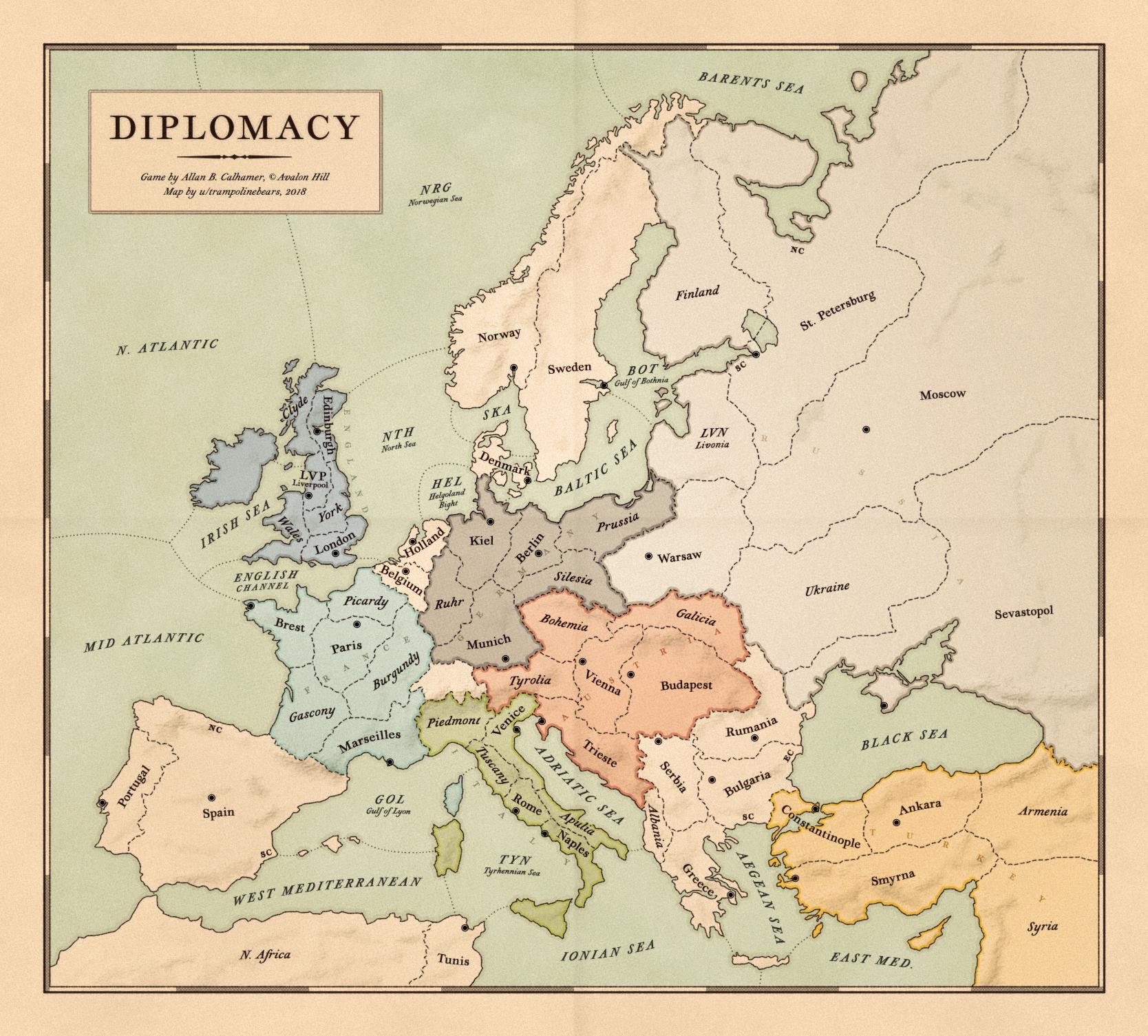
Calhamer's rules created several computational nightmares that resisted classical computer science for decades:
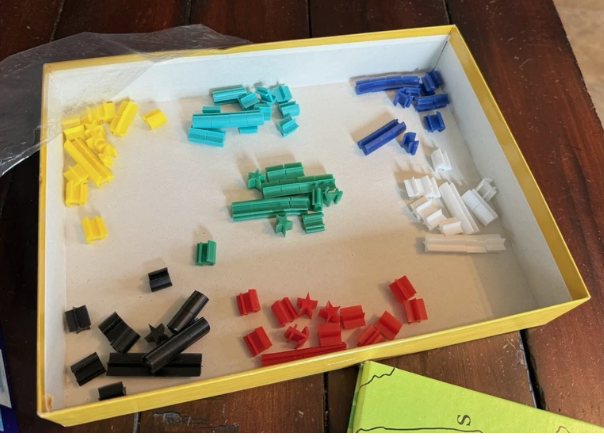
- Combinatorial Explosion: Because all 34 units on the board move simultaneously, the number of possible joint actions in a single turn exceeds 1020. For comparison, Chess has approximately 35 valid moves per turn.
- Simultaneous Resolution Paradoxes: Convoys, cut supports, and circular retreats can create topological paradoxes (such as the famous Pandread Convoy Paradox) that break naive algorithmic loops[5].
- The Social Contract: Pure tactical play ("Gunboat" or "No-Press") reduces the game to a bleak attrition grind. The true game takes place in the private negotiations ("Press")—whispered corridors where players form non-binding pacts, manufacture disinformation, and negotiate coordinated maneuvers.
💾 3. The Judge & DATC: Early Computing Era (1984–1999)
The earliest intersection of computers and Diplomacy began not with bots that played, but with computers acting as the Grand Arbiter. In 1984, before the World Wide Web, enthusiasts began playing Diplomacy over BITNET and early Arpanet via Play-By-Email (PBEM).
In 1990, Ken Lowe created The Judge[6]—an automated email daemon that accepted orders from 7 human players, verified their syntactic validity, and executed simultaneous turn adjudication. Over the next decade, dozens of Judge servers connected thousands of human players across the globe.
However, codifying Calhamer's rules into software proved fiercely difficult. Ambiguities in rule phrasing led to discrepancies between different Judge programs. In 2000, Dutch mathematician Lucas Kruijswijk published the DATC (Diplomacy Adjudication Test Cases)[5]—a monumental treatise containing hundreds of edge-case scenarios that established the definitive mathematical specification for programmatic Diplomacy adjudication.
🤖 4. The DAIDE Era: Symbolic Negotiation (2002–2015)
With adjudication solved by the DATC, artificial intelligence researchers turned to building autonomous bots. But how could a computer negotiate in a game played in natural English?
In 2002, David Norman launched the DAIDE (Diplomacy Artificial Intelligence Development Environment) project[7]. Recognizing that natural language processing was too primitive in 2002, DAIDE invented a formal, machine-readable language for diplomatic communication.
PRP ( ALY ( ENG FRA ) VSS ( GER ITA ) )Translation: England proposes a military alliance with France against Germany and Italy.
NOT ( PRP ( SUP ( ( FRA AMY BUR ) MTO MUN ) ) )Translation: Germany rejects the proposal to support the French Army in Burgundy into Munich.
Annual Computer Diplomacy Competitions were organized at international academic conferences (IJCAI, ECAI)[8]. Notable bots emerged:
- Albert (Jason van Hal): One of the first successful heuristic-based negotiation bots.
- DumbBot: A minimal tactical baseline used as a benchmark for rule compliance.
- HaGraph & Bordeaux (Fabrice Lapeyre): Evaluated territories using heuristic graph flow algorithms.
- DipBlue & Darkbot: Focused on fast tactical tree search for no-press games.
Despite impressive engineering, the DAIDE paradigm hit a hard ceiling. Human players quickly realized that DAIDE bots were hopelessly rigid. They could not detect sarcasm, could not assess when an ally was setting a strategic trap, and broke down completely when faced with human psychological nuance.
🧠 5. Deep Reinforcement Learning & No-Press Breakouts (2018–2021)
By 2018, the deep learning revolution reached Diplomacy. Researchers at McGill University, Mila, and Facebook AI Research (FAIR) recognized that online Diplomacy websites (notably webDiplomacy.net) had accumulated millions of human moves over two decades.
In 2019, Paquette et al. published DipNet[9], training deep convolutional and recurrent neural networks on 130,000 human games. DipNet demonstrated that imitation learning could match expert human tactical execution in "No-Press" (gunboat) Diplomacy.
In 2020, FAIR and DeepMind researchers extended this with equilibrium search algorithms (such as regularized policy iteration)[10]. Yet everyone recognized that No-Press Diplomacy was essentially a tactical miniature of the real game. The true grand challenge—Full-Press Diplomacy with unconstrained natural language—remained widely regarded as a decades-away problem.
👑 6. The Watershed: Meta's CICERO (November 2022)
In November 2022, the artificial intelligence world was shaken by a breakthrough paper published on the cover of the journal Science: "Human-level play in the game of Diplomacy by combining language models with strategic reasoning" by Meta's Fundamental AI Research (FAIR) team, led by Noam Brown and Adam Lerer[11].
Their AI, dubbed CICERO, was deployed secretly and anonymously onto webDiplomacy.net into an active blitz tournament against experienced human players. CICERO played 40 complete games as various Great Powers.
| Metric | Average Human Player | Meta's CICERO AI |
|---|---|---|
| Tournament Standing | 50th Percentile | Top 10% (Ranked 2nd out of 19 multi-game players) |
| Average Score | 12.8% per game | 25.8% (More than double human average) |
| Messages Sent | ~150 messages/game | 5,277 messages across 40 games |
| Human Detection | N/A | Zero players suspected they were chatting with an AI |
The Architectural Secret: Decoupling Strategy from Dialogue
Why did CICERO succeed where others failed? Meta's researchers did not simply ask a Large Language Model to play the game. Doing so leads to immediate disaster: LLMs hallucinate board state, promise mutually contradictory moves, and quickly get dogpiled.
Instead, CICERO combined two distinct engines operating in a tight feedback loop:
- The Strategic Planning Engine (pi-KL Regularized Policy Iteration): A game-theoretic algorithm that calculates joint probabilities of other players' moves and computes approximate Nash equilibria without assuming opponents will act like machines.
- The Dialogue Engine (2.7B Parameter Controllable Transformer): A dialogue model trained on human diplomacy press, conditioned strictly on intent vectors provided by the strategic engine. The model does not invent promises; it translates the strategic plan into charming, natural English prose.
Popular culture assumes that Diplomacy is a game of ruthless backstabbing. But Meta's research revealed a profound mathematical truth: the most successful players are overwhelmingly honest. Players who lie habitually acquire a reputation for treachery within two turns, prompting other powers to form a coalition to eliminate them. CICERO was specifically tuned to be a dependable, highly collaborative ally who only broke agreements when strategically forced by the board state.
📺 7. The Video Record & The Modern LLM Frontier (2023–2026)
Watch how human experts interact with CICERO in real-time. In this match analysis, expert Diplomacy commentator CaptainMeme plays a full-press game against Meta's CICERO agents, illustrating the speed, negotiation finesse, and tactical coordination of the AI:
The LLM Era & The APC Military BBS
Between 2023 and 2026, the rise of open-weight LLMs (Llama 3, Mistral Nemo, Qwen 2.5, DeepSeek) opened new horizons for hobbyists and researchers. However, the fundamental lesson of 40 years of computer Diplomacy remains unchanged:
- Pure Language Models Fail at Tactics: If you leave board moves to raw LLM prompt completion, models will hallucinate adjacent territories, march fleets over mountain ranges, and contradict their own treaties.
- Pure Math Engines Fail at Humans: If you use only game theory and minimax trees, humans will band together and wipe the silent bot out of Europe.
- The Winning Architecture is the Hybrid Baton: Ground the physical board in a deterministic referee engine (like our SQLite DATC spool in
memory/apc_bbs.db), while letting diverse LLM personas negotiate, debate, and pass the baton.
Annotated Scholarly References & Footnotes
- Campbell, M., Hoane, A. J., & Hsu, F. H. (2002). Deep Blue. Artificial Intelligence, 134(1-2), 57-83. ↩ Back
- Silver, D., Huang, A., Maddison, C. J., et al. (2016). Mastering the game of Go with deep neural networks and tree search. Nature, 529(7587), 484-489. ↩ Back
- Von Neumann, J., & Morgenstern, O. (1944). Theory of Games and Economic Behavior. Princeton University Press. ↩ Back
- Calhamer, A. B. (1959). Diplomacy: The Game of International Intrigue. Self-published (1959); Avalon Hill (1961). See also Calhamer, A. B. (1984), "The Invention of Diplomacy," Games Magazine. ↩ Back
- Kruijswijk, L. (2000). The Diplomacy Adjudication Test Cases (DATC). Standard specification for programmatic resolution of simultaneous moves and paradoxes. Available online at diplom.org/Zine/S2009M/Kruijswijk/DATC.htm. ↩ Back
- Lowe, K. (1990). The Judge: An Automated Play-By-Email Diplomacy Adjudicator. Published in The Diplomatic Pouch. ↩ Back
- Norman, D. (2002). DAIDE: The Diplomacy Artificial Intelligence Development Environment. Formal grammar specification for computer-mediated strategic communication. ↩ Back
- Fabregues, A., & Sierra, C. (2011). DipBlue: An agent for the game of Diplomacy. Proceedings of the International Joint Conference on Autonomous Agents and Multiagent Systems (AAMAS). ↩ Back
- Paquette, P., Lu, Y., Bohn, S. U., et al. (2019). No-Press Diplomacy from Scratch via Deep Reinforcement Learning. Advances in Neural Information Processing Systems (NeurIPS 2019), McGill / Mila / FAIR. ↩ Back
- Bakhtin, A., Wu, D. J., Lerer, A., & Brown, N. (2021). No-Press Diplomacy from scratch with equilibrium search. International Conference on Learning Representations (ICLR 2021). ↩ Back
- Meta Fundamental AI Research Diplomacy Team (FAIR), Bakhtin, A., Brown, N., Dinan, E., Farina, G., Foerster, J., Goff, A., Lerer, A., et al. (2022). Human-level play in the game of Diplomacy by combining language models with strategic reasoning. Science, 378(6624), 1067-1074. DOI: 10.1126/science.ade9097. ↩ Back